Homework: Read the background material below and compose a 2-3 page journal response: Where do you see Austen's life and values in her novel? Use direct evidence from both texts.
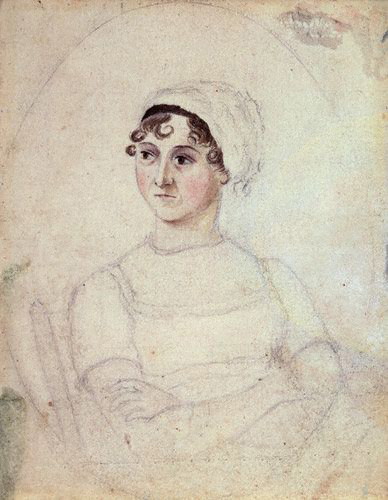
Jane Austen’s Life
Jane Austen’s Life
While the literary art of Jane Austen is remarkable, the
facts of her biography, at first glance, are not. The contrast has long
intrigued Austen readers and scholars, and interest in her life is today almost
as keen as interest in her works. Dating back to her own time, when Austen's
first four novels were published anonymously, sources of information about her
life still exist — some of her letters (those her sister Cassandra did not
destroy after her death), and A Memoir of Jane Austen, written by her nephew
J.E. Austen-Leigh in 1869. These sources reveal that Austen did lead the quiet
life of an unmarried clergyman's daughter. She found early encouragement for
her art within her family circle, and a starting point for her novels in her
personal and family history.
Born in 1775 to George and Cassandra Austen in the English
village of Steventon, Jane Austen grew up in a highly literate family. Austen's
father was an Oxford-educated clergyman and her mother was a humorous,
aristocratic woman. Educated only briefly outside of her home, Austen read
freely in her father's library of 500 books, which left her better educated
than most young girls of the time. While her family never anticipated she would
be a published writer (not considered an appropriate profession for a young
lady of her background), within the walls of their household she was encouraged
to write. In this lively intellectual household, the 15-year-old Austen began
writing her own novels; and by age 23 she had completed the original versions
of Northanger Abbey, Sense and Sensibility, and Pride and Prejudice. Her own
delight in reading and her ironic mocking of its impact on young girls comes
alive in Northanger Abbey.


After Austen's father died in 1805, Jane, her mother, and
sister Cassandra lived in a small house provided by her then-wealthy brother
Edward in the village of Chawton. When Jane received a proposal from the
wealthy brother of a close friend, for whom she felt no affection, she
initially accepted him, only to turn him down the next day. This was a painful
decision for her, as she understood deeply that marriage was the sole option
women had for social mobility. She further understood the vulnerability of
single women without family estates who depend on wealthy relatives for a home.
This subject is at the heart of Sense and Sensibility.
Austen keenly observed the shifting of social class during
her day. Two of her brothers were in the Royal British Navy, and she saw
first-hand the rise of naval officers in class-conscious British society. Those
who returned from the Napoleonic wars with both wealth and notoriety were able to
break through class barriers that were previously impenetrable. She wrote
elegantly about this sea change in her last novel, Persuasion.
Jane Austen died on July 18, 1817, at age 41. She never
wrote a memoir, sat for an interview, or recorded whether she had herself felt
the joys and disappointments of love. The biographical facts may never
adequately explain the quick wit, the sharp insight, and the deep emotional
intelligence she brought to her novels. Perhaps that is impossible; it is
likely that the novels will continue to transcend our understanding of where
they came from.
Jane Austen's Family Tree

Regency Era
The Regency era spans the reign of the Prince of Wales from
1811 to 1820. It occurred at the latter end of the Georgian period when King
George III was declared unfit to rule for reasons of insanity and his son,
George IV was appointed as Regent to govern the country. The Prince Regent was
notable for his lack of restraint in most areas of life. He was a womanizer who
over-ate, over-drank and over-spent. As such he lost the respect of many of his
subjects, including Jane Austen herself. In fact, she mocks over-indulgence and
vanity of all kinds, while restraint is depicted as a mark of character
strength. Nevertheless, his extravagance characterized the period and his
patronage of the arts resulted in marked expansion in the areas of:
1) Architecture
(typified by the elegant designs of architect John Nash)
2) Literature
(typified by work of Romantic writers Austen, Byron, Shelley and Keats)
3) Music (typified by
the works of Beethoven, Schubert and Liszt).
4) The character of
Sir Walter in Persuasion could be interpreted as a parody of the Prince Regent.
A widening gap between rich and poor
While the upper classes in the Regency era were enjoying an
opulent lifestyle, the lower classes experienced a grinding poverty. The Prince
Regent made little effort to relieve the situation and his lavish lifestyle
caused a growing resentment. The gap between rich and poor was exacerbated by:
1) A sudden increase
in the population and increasing overcrowding in the cities, which led to
squalid housing conditions. This gave rise to city slums (colloquially known as
rookeries). They were associated with prostitution, drunkenness and crime in
general
2) Inflated food
prices, due to Napoleon's blockade of exports to Britain, as well as high
wheat prices resulting from the Corn Law of 1815
3) Technological
advances in the textile industry which eventually wiped out spinning as a
cottage industry - hence the Luddite Riots (1811-1816) in which English
craftsmen protested about the negative impact of technological advances on
employment in the weaving industry.

Major Works
Lady Susan
Lady Susan was possibly written in 1794 but not
published until 1871. Beautiful,
flirtatious, and recently widowed, Lady Susan Vernon seeks an advantageous
second marriage for herself, while attempting to push her daughter into a
dismal match. A magnificently crafted novel of Regency manners and mores that
will delight Austen enthusiasts with its wit and elegant expression. The entire
novel is composed of letters, offering different viewpoints, with an epilogue
tying the events together. The film adaptation
is titled Love and Friendship (2016), not to be confused with her juvenilia
novella of the same name.
Northanger Abbey
Jane Austen's first major novel was written in 1798-99, when
she was in her early twenties. It is a comic love story set in Bath about a
young reader who must learn how to separate fantasy from reality. Miss Austen
sold the novel (then entitled Susan) to a publisher in 1803, and the
work was advertised but never published. She bought it back many years later,
and her brother Henry Austen published the novel as Northanger Abbey
after her death in 1817.
Sense and Sensibility
Sense and Sensibility was the first of Jane Austen's
novels to be published. She began to write it sometime around 1797, and she
worked on it for many years before its publication in 1811. The title page said
that it was written "By a Lady", and only her immediate family knew
that Jane Austen was the author. Impetuous Marianne Dashwood tumbles into a
fairytale romance that goes sour, and her practical older sister Elinor copes
with the family's financial problems while hiding her own frustrated romantic
hopes. The book was a success, and it even earned a profit!
Pride and Prejudice
Pride and Prejudice was first written in the late
1700's, then rewritten in 1811-1812 and finally published in early 1813. It is
probably the most-read of all of Jane Austen's novels and is a popular favorite
among many. Originally entitled First Impressions, the novel deals with the
misjudgments that often occur at the beginning of an acquaintance and how those
misjudgments can change as individuals learn more about each other.
Mansfield Park
Mansfield Park was written between February, 1811 and
the summer of 1813. It was the third novel Jane Austen had published and it
first appeared on May 4, 1814. During her lifetime, it was attributed only to
"The author of Sense and Sensibility and Pride and Prejudice",
and the author's identity was unknown beyond her family and friends. It is Jane
Austen's most complex novel and deals with many different themes, from the
education of children, to the differences between appearances and reality.
Emma
Emma was written in 1814-1815, and while Jane Austen
was writing it, it was suggested to her by a member of the Prince Regents'
household that she dedicate it to His Royal Highness. Austen took the
suggestion as it was intended--as a command--and Emma was thus dedicated, but
the dedication itself is rather slyly worded. Emma deals with a young woman's
maturation into adulthood and the trouble she gets herself into along the way.
Persuasion
Persuasion was written in 1815-1816, while Jane
Austen was suffering from her fatal illness. She was still working on some
revisions at the time of her death in 1817. The novel was published
posthumously by her brother, Henry Austen. Persuasion is a novel of second
chances, expectations of society, and the constancy of love. You can also read
the preface which Henry wrote telling the world of his sister's authorship,
life, and untimely death: A Biographical Notice of the Author.
Juvenilia & Letters
Jane Austen's works from her childhood are full of
enthusiasm, humor, and very creative spelling. We also have some letters and
correspondence, though Jane’s sister destroyed any that could have given us
insight into her psyche and love life.